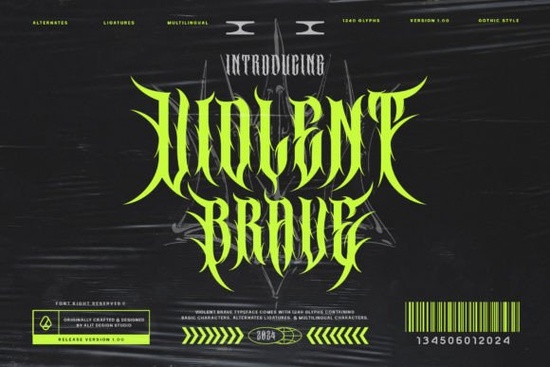
When you need a typeface that commands attention without relying on flashy graphics, the Violent Brave Font delivers exactly that kind of raw visual weight. This brutalist style cuts through busy layouts by leaning into sharp angles, heavy strokes, and a distinctly unapologetic structure. It works well for creators who want their typography to carry the same intensity as a live show or a limited-run streetwear drop. Rather than softening edges or adding decorative flourishes, this font strips away excess to focus on form, contrast, and momentum.
What makes a brutalist display font different from standard bold types?
Most commercial bold fonts still follow conventional proportions. They stay safe within predictable baseline measurements and rely on uniform stroke weights. The Violent Brave Font takes a different approach. Each character is built around aggressive slabs, jagged terminals, and asymmetrical counters that suggest movement even when sitting completely still. That deliberate imbalance gives brands and personal projects a memorable edge without crossing into unreadable territory.
Designers often pair this style with clean, neutral backgrounds so the letterforms can breathe. Craft sellers find it works beautifully on dark t-shirts, patch patches, and sticker packs where high contrast matters. Small business owners use it for sale banners and limited edition drops because the heavy strokes hold up well when scaled down to business card sizes or blown up onto large signage.
Does the included character set actually save time during production?
Yes. With 1,240 glyphs, this package covers far more than basic English punctuation. You get a full range of ligatures, contextual alternates, and alternate characters that change how a word feels without requiring manual adjustments. If you are typing out a band name, event poster headline, or product label, those alternates let you swap specific letters instantly. The multilingual PUA Unicode block also means you can type accented vowels, regional symbols, and special characters that many budget packages simply miss. This reduces the need to jump between multiple font files or worry about missing symbols on final print proofs.
Which project types match this heavy typographic approach?
The strongest use cases align with music culture, alternative fashion, and bold branding. Print-on-demand sellers regularly pull this style for album cover templates, gig flyers, and concert merchandise because the layout naturally supports high-energy imagery. Graphic designers use it for logotypes that need to feel established yet rebellious. Hobbyists working on zines, scrapbooking, or hand-lettered journal covers often appreciate how quickly it communicates attitude.
If you enjoy this structural aggression but occasionally need softer historical influences, you might also look into related blackletter fonts that blend medieval heritage with contemporary spacing. Mixing strict slab structures with ornamental details creates visual rhythm that keeps long headlines from feeling repetitive.
How do you maintain readability when pairing loud typefaces?
A font this dominant needs room to work. The easiest way to balance it is by restricting its use to titles, short captions, or logo marks. Keep body copy in a simple, neutral sans serif or humanist text font so readers never have to struggle against competing weights. Set tight tracking on all-caps headers to lock the aggressive shapes together, but leave extra breathing space between lines to prevent ink bleed on lower-quality prints. Test your combinations at actual output size before sending files to press, since heavy descenders and extended crossbars often shift position during scaling.
Many creators also choose to export this family in vector format for crisp scaling across web mockups and physical cut files. You can easily find the complete library and preview variations across different languages by visiting the official listing for Violent Brave Font. Checking the sample sheet before purchasing will help you verify which alternates fit your preferred layout density.
Ready to test this style in your next project?
- Check file compatibility: Verify that your design software supports OpenType ligatures and alternate character mapping.
- Set up a test layout: Place three headline lengths alongside your body text to confirm visual hierarchy.
- Run a color contrast check: Ensure your foreground and background meet basic legibility standards before exporting.
- Export in multiple formats: Save as PDF for proofing, SVG for cutting machines, and PNG with transparent backgrounds for social previews.
- Document your pairing rules: Note which subheaders and accent colors work best so future projects stay consistent.
Start with a single line of text on a contrasting background. Adjust kerning until the sharpest edges sit evenly apart. Once the flow feels natural, scale it to your final dimensions and run a quick print or screen mockup. You will quickly see whether the heavy structure meets your project needs before committing to a full batch production.
Download Now The Ab Typewriter Font: a Timeless Design Tool
 A Creative Guide to the Strawberry Shortcake Font
 Miracle Groovy Font for Creative Design Projects
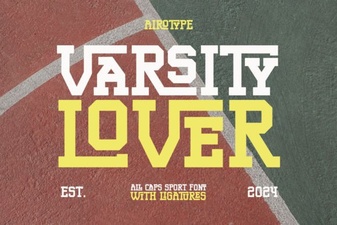 Unlock Your Creativity with the Varsity Lover Font
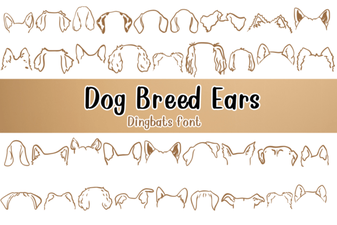 Designing with Typography Inspired by Dog Breeds
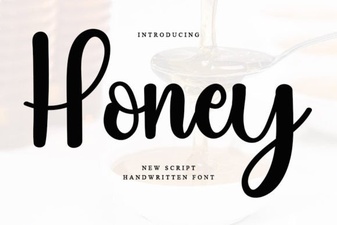 Honey Font: Sweet Design Typography for Modern Projects